

In this video Michael Reimer gives Founders a five minute front door test: call your own business from a number your team does not know, then fill out your own website form with a timer running. It shows what a new customer goes through before you spend more on leads, a new website or another tool.
He opens with a question. When was the last time you called your own business? Not your cell, but the number on your website that customers call. Most owners assume they know how that call goes. Michael's answer is a story about someone who assumed the same thing.
What is the speakerphone story Michael tells?
As Michael tells it, Jeff Bezos was in a meeting with his executives at Amazon years ago. Customers had been complaining about long hold times. He asked the person running customer service how long people were waiting. The answer came back with confidence: less than a minute.
He did not write it down and move on. He reached for the speakerphone on the table and dialed the customer service number in front of everyone. Then the room waited. A minute went by, then another, and it kept going. The report said one thing and the phone said something else.
Michael returns to that room at the end of the video. He does not read it as a man trying to embarrass anybody. He reads it as a Founder who refused to run his company off a report. Anyone in the room could have made that call on any day of the year. It took one person who wanted to know.

Why can't you see your own front door?
Michael spends much of his time coaching Founders. When one tells him the business is not growing, he hears the same list. They need more leads. The marketing is not working. Maybe a new website, maybe TikTok, maybe another AI tool because a competitor got one. He understands it. Payroll is coming and the phone is not ringing the way it used to, so the owner goes looking for something new to buy.
His point is that you are the one person in your company who has never been your own customer. He compares it to a house. Every house has a smell. You notice it the moment you walk into a neighbor's place, but you cannot smell your own, because you stopped noticing years ago. In your business you know where everything is and who to ask. Nobody has ever put you on hold.
So he asks one question before anything else: what happens when a stranger tries to give you money? Not what is supposed to happen. What happens. Almost every time, he says, the Founder answers with what is supposed to happen. The phone rings up front, the front desk picks it up, it goes on the calendar and a confirmation goes out. Michael's reply is short. Great, let's call it.
What does a front door problem look like?
His example is a dental office. The owner spends good money on ads, the leads come in and the schedule still has holes. So the owner figures the office needs more advertising. Maybe it does.
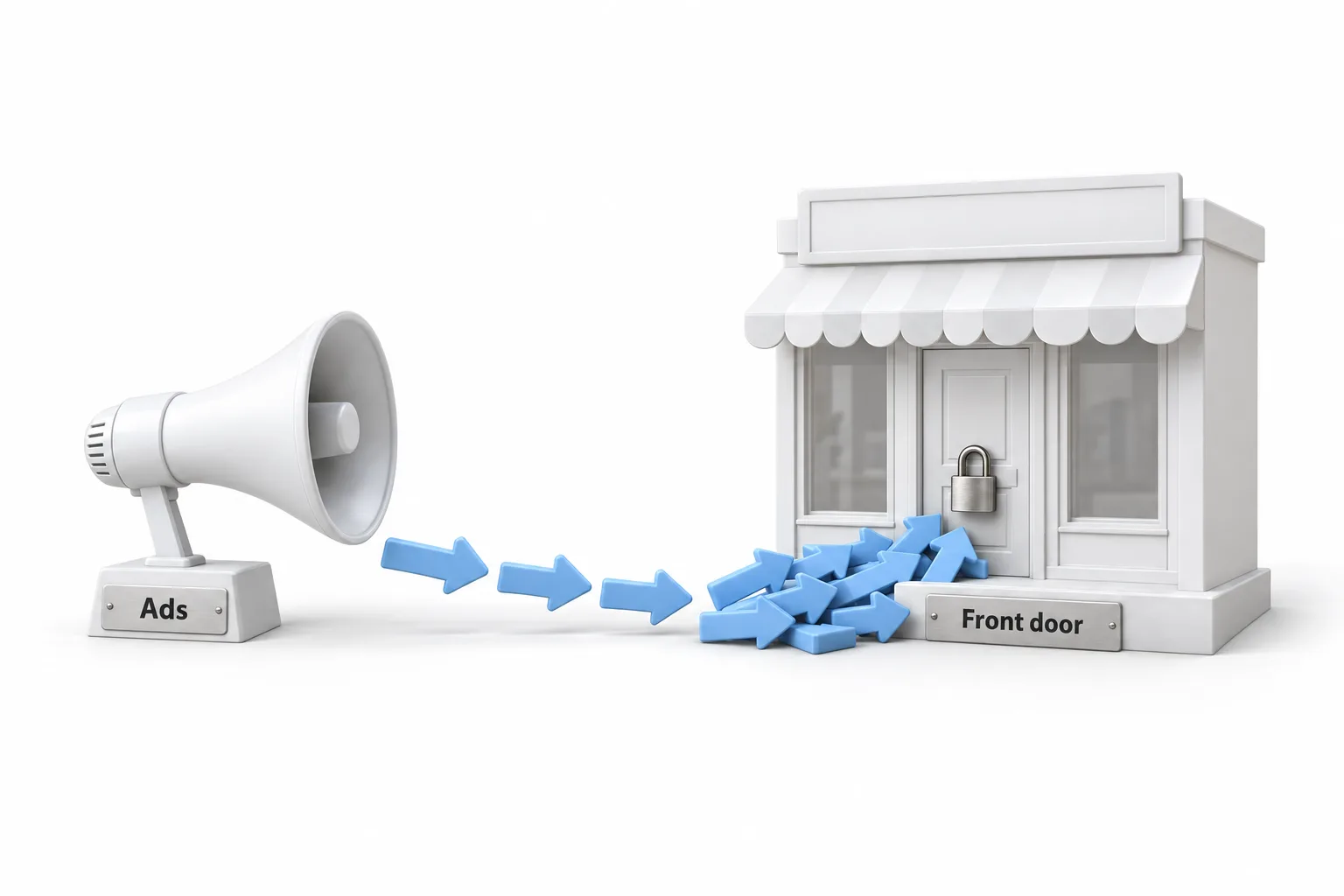
But suppose the owner called the office number at 12:15 on a Tuesday. Suppose it rang six times and went to a voicemail that was full. Or suppose the owner filled out the form on the website and nobody ever got back. That is a different problem. In Michael's words, it is not a marketing problem. It is a front door problem. The office has been paying to send people to a store with the door locked, while the owner stands inside wondering why nobody comes in.
Is the front desk to blame when the test goes badly?
No, and Michael is firm about it. He says not to walk in the next day and yell at the front desk. That person is checking somebody in with the phone ringing and a third thing on their plate. They are not the problem. Nobody ever built them a system.
The fixes he lists are usually not complicated. Every missed call gets a text back within a minute. Every form gets answered right away with a way to book. AI answers the phone after hours, so nobody reaches a voicemail at 9:00 at night. He notes that platforms like HighLevel, which many people search for as GoHighLevel, bring a lot of those systems together. The guides on missed call text back, building a booking funnel and setting up an AI receptionist cover those three.
He adds that the technology is not the most important part of the story. You cannot fix a door you have never tried to walk through.
How do you run the front door test on your own business?
The challenge is free and Michael says it takes five minutes. The fixes follow from what you find.
- Call at lunchtime. Use a number your team does not know, and time how long it takes for a person to help you.
- Fill out your own form. Start a timer and note when, or whether, anyone gets back to you.
- Look at what happened. Go by what took place, not what is supposed to happen, and do not blame the front desk for it.
- Text back missed calls. Set up a text that goes out within a minute of every missed call.
- Answer every form. Reply right away with a way to book.
- Cover after hours. Let AI answer the phone at night, and keep people on the calls that need care.
What changes once you have walked through your own front door?
You stop guessing. Michael says the test will tell you more than your last three marketing reports. An owner who was blaming the marketing, the market and the team may find it was one phone call the whole time.
It also changes what you automate. Michael tells Founders that being able to automate something does not mean you should. A customer who is scared or has a real problem wants a person who cares. So he says to take the waiting out and leave the humans in. The technology catches what falls on the floor, and your people look after the customer in front of them.
His last line is the reason to do it tomorrow. The biggest risk in your business might not be your competition. It might be the one phone call you have never made. For the next step after the test, see his video on fixing slow lead follow up.
Still evaluating HighLevel? Start with the 30 day GoHighLevel free trial through Michael's link and test it in your own account. If you are deciding on the top plan, see who should get the Founder Plan.