Home/Founders/Founder vs entrepreneur
Founders · Comparison
Founder vs entrepreneur. Overlapping words, different focus.
The two words are often used interchangeably, and most Founders are entrepreneurs. But the emphasis differs. An entrepreneur chases opportunity. A Founder builds a specific company and stays to make it work. Here is the distinction and why it matters for how you spend your time.
The short answer
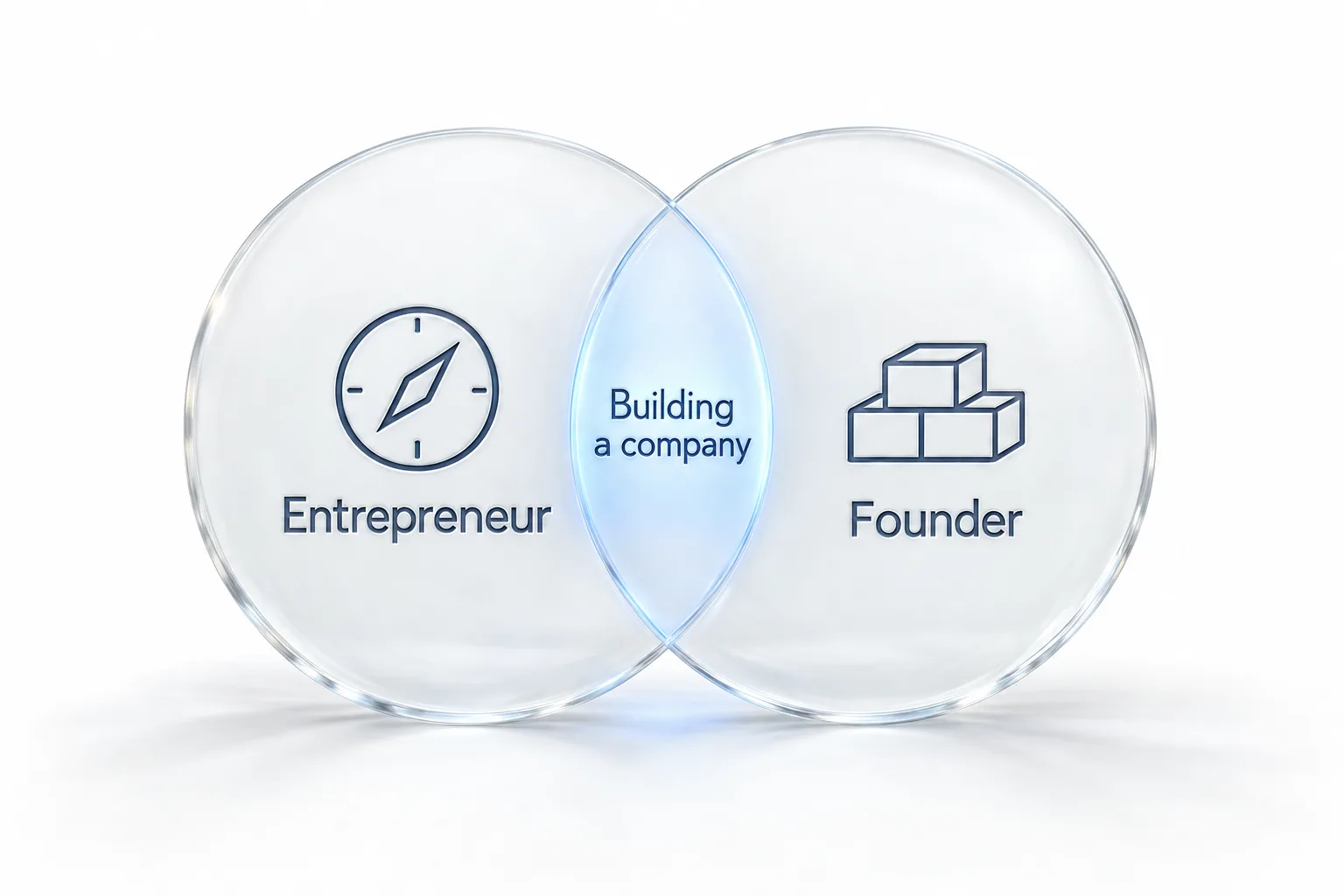
An entrepreneur pursues business opportunities and takes on the risk, often across several ventures. A Founder starts one specific company and stays to build it, including its offer, systems, team and first customers. Most Founders are entrepreneurs, but not every entrepreneur founds and builds a single company for the long run.
Side by side
What is the difference between a Founder and an entrepreneur?
| Entrepreneur | Founder | |
|---|---|---|
| Focus | Spotting and pursuing opportunities | Building one company |
| Time horizon | Often deal by deal or venture by venture | Years, in one business |
| Core skill | Seeing and testing ideas | Turning an idea into a system that runs |
| Measure of success | Wins across ventures | A company that works without them in every seat |
Why it matters
Why act like a Founder once you commit?
The entrepreneur's instinct is to chase the next idea. Once you commit to a company, the Founder's job is the opposite: say no to most ideas and build systems for the one you chose.
I have been both. The money came when I stopped chasing new ideas and started building systems for the one I had.
Common ground
Where do Founder and entrepreneur overlap?
In everyday speech the two words are used for the same people, and that is mostly fine. Both describe someone who takes a risk to create a business instead of working in one. Both sell, both make decisions without certainty and both live with the results.
The difference shows up in what the word emphasizes. Entrepreneur describes a disposition: seeing an opportunity and going after it. Founder describes a relationship to one company: you began it, and you are building it. A person who buys an existing business is an entrepreneur and not its Founder. A person who starts a company and spends years on it is both.
So you do not have to choose a label. It is more useful to ask which behavior your business needs from you right now.
By stage
Which mode does your business need now?
Early on, the entrepreneur's habits help. You are looking for a problem worth solving, testing offers and dropping the ones that do not land. Curiosity and speed matter more than polish. The pages on whether you need an idea and how to validate a business idea belong to this stage.
Once an offer sells, the need flips. The business now requires someone to deliver the same result again and again, write down how it is done and turn that into systems. That is Founder work. It is slower and less exciting than chasing a new idea, and it is where a company is actually built.
Many people who are good at the first stage struggle with the second. The signal is a string of promising starts and nothing that runs without them. If that is familiar, the fix is not a better idea. It is staying with the current one long enough to systemize it.
In practice
How do you stay focused on one company?
- Keep a not now list. Write new ideas down and close the notebook.
- Set a review date, such as once a quarter, to look at that list.
- Measure the business you have every week, so progress is visible.
- Give routine work to systems and AI, so focus does not mean exhaustion.
The last step is what makes long focus realistic for one person. The page on how Founders use AI agents shows which jobs to hand over, and the Founder mindset covers the habits behind it. On HighLevel, HighLevel plans compared shows what each plan includes, the Founder Plan FAQ covers the plan made for Founders, and the 30 day trial through Michael's link gives you a month to hand the first routine job to a system.
Questions
Common questions.
What is the difference between a Founder and an entrepreneur?
An entrepreneur pursues business opportunities and takes on the risk, often across several ventures. A Founder starts one specific company and stays to build it, including its offer, systems, team and first customers. The words overlap, but the focus differs: opportunity for one, a single company for the other.
Is every Founder an entrepreneur?
Almost always. Starting a company means spotting an opportunity and taking on risk, which is what an entrepreneur does. So most Founders are entrepreneurs. The Founder label adds something more specific: this person started this particular company and stayed to build it.
Is every entrepreneur a Founder?
No. Not every entrepreneur is a Founder. Some pursue deals or ventures, buy existing businesses or invest, without starting and building one company for the long term. They are entrepreneurs because they take on business risk, but Founder is kept for the person who started a company.
Can you be both a Founder and an entrepreneur?
Yes. Most Founders are entrepreneurs. The words describe different things: one is a role in a specific company and the other is a way of pursuing opportunity. You do not have to choose a label. What matters is which mode your business needs right now.
Is a serial entrepreneur a Founder?
They are the Founder of each company they started. The term serial entrepreneur points to the pattern of starting several. So both words apply: Founder for the role in each company, and serial entrepreneur for the habit of beginning new ones.
Is a small business owner a Founder?
If they started the business, yes. If they bought it or took it over, they are the owner but not the Founder. Size does not matter. A one person company still has a Founder, and it is the person who began it.
Next step
See it in your own account. Thirty days, every feature.
Start a trial, build the first system and test it before the first invoice. Usage fees for phone, SMS, email and AI can apply during the trial.
HighLevel has three plans at a flat monthly price, each with unlimited users and contacts. See what each one includes and what it costs.
Compare the PlansStarter, Unlimited and Founder