
Home/Founders/How to become a Founder
Founders · Path
How to become a Founder. Start with a problem, not a product.
Becoming a Founder does not start with a business plan or a logo. It starts with a problem you understand and people willing to pay to have it solved. This is the practical path, in the order the decisions come up.
The short answer
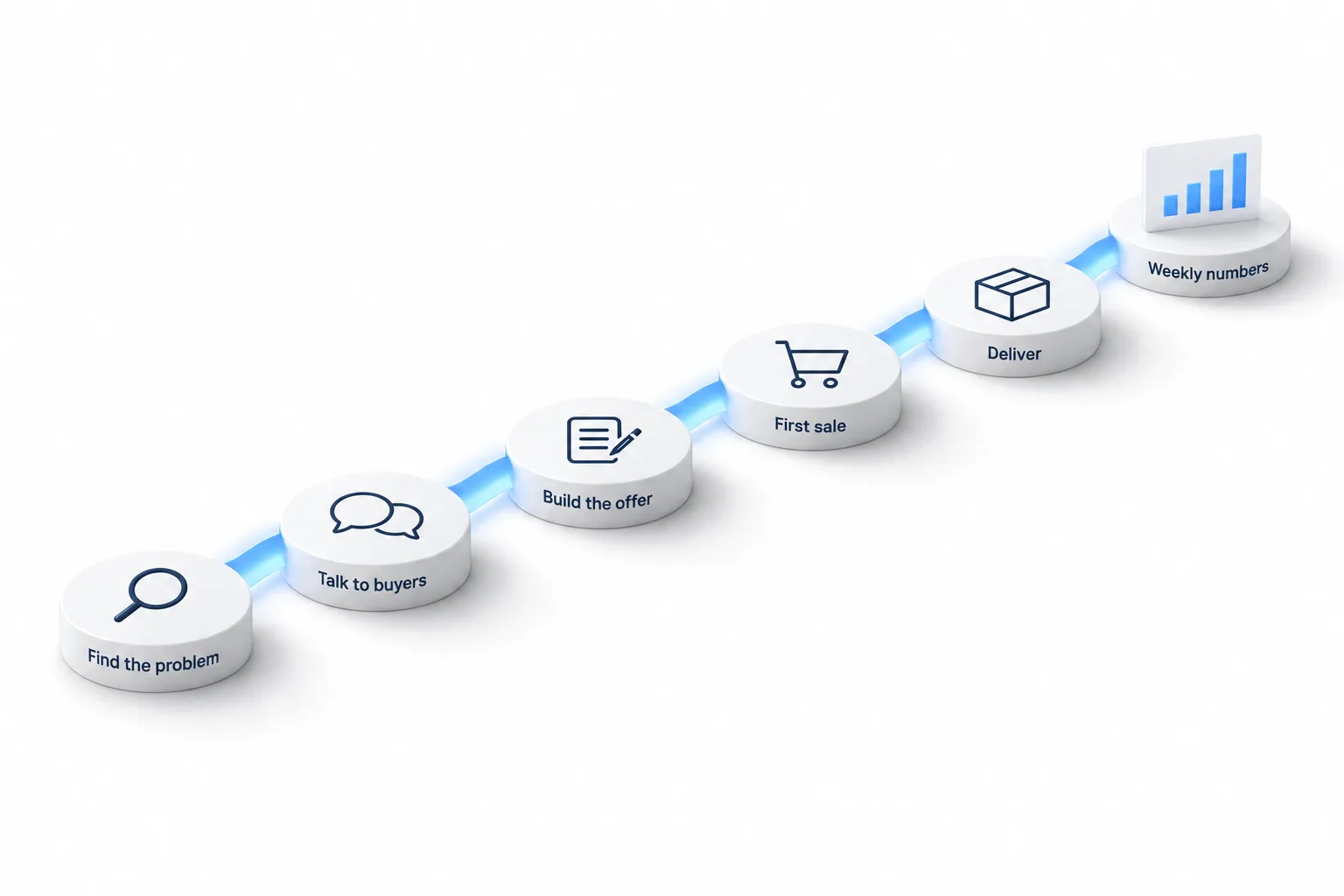
To become a Founder: pick a problem you understand for people you can reach, validate it with buyers, build the smallest system that solves it, sell before you scale, put systems behind every repeated task and review a few numbers weekly. You do not need funding, a co Founder or technical skill to start.
The path
What are the six steps to becoming a Founder?
- Pick a problem. One you have lived or seen up close, for people you can reach.
- Validate it. Talk to twenty potential buyers. Ask about the problem, not your idea.
- Build the smallest solution. Often a service first, then a system.
- Sell it. Get paying customers before you build more.
- Systemize. Put a system and an owner, human or AI, behind every repeated task.
- Measure. Review five numbers every Monday.
What you do not need
Which myths stop people starting?
- You do not need an original idea; you need a problem people pay to solve
- You do not need funding to start a service or systems business
- You do not need to code
- You do not need to quit your job first

Every business I built started as a problem I understood better than most. Start there.
Definition
What counts as being a Founder?
A Founder is the person who starts a company and owns its outcome. There is no license, no minimum size and no approval. You become one by doing three things: creating an offer, getting a customer to pay for it and taking responsibility for delivering it.
That is a lower bar than most people assume and a higher one than it sounds. Lower, because you do not need an office, investors or staff. Higher, because registering a company name or building a website does not make you one. A paying customer does.
On this site the word has a second meaning too. HighLevel named its top plan the Founder Plan. You can be a Founder in the first sense on any GoHighLevel plan, or with no software at all. The what is a Founder page explains both meanings.
A realistic shape
What does the first year look like?
The six steps are not equal in length. Here is roughly how they tend to spread out, though every business differs.
- First weeks. Conversations with buyers and a first offer. Mostly talking, very little building.
- First months. A handful of customers, delivered by hand, with notes on what repeats.
- Middle of the year. The repeated work becomes systems: answering, follow up, onboarding and reporting.
- Later in the year. You measure what is working, narrow to the best customers and decide what to add.
The pattern to notice is that selling comes before building, and systems come after delivery. People who reverse the order spend months on things no customer asked for. The first 90 days plan covers the opening stretch in detail.
Your situation
Which starting path fits your situation?
The steps are the same for everyone. The route into them depends on where you are now.
- Employed and want to keep your income: become a Founder while working full time.
- New to business altogether: become a Founder with no experience.
- Unsure what to sell: AI business ideas.
- Wondering about the risk: is being a Founder worth it.
Pick the one that matches and start with its first step this week.
When the first system is ready to build, the GoHighLevel 30 day trial through Michael's link gives you an account to build it in. GoHighLevel plans compared shows which plan fits a new Founder, and the Founder Plan FAQ answers the common questions about the top plan.
Questions
Common questions.
How do I become a Founder?
To become a Founder, pick a problem you understand for people you can reach, validate it with buyers, build the smallest solution, sell it, put systems behind the repeated work and measure a few numbers weekly. You do not need funding, a co Founder or technical skill to begin. You need one buyer with a real problem.
Do I need money to become a Founder?
Not for many service and systems businesses. The starting costs are usually a platform plan, a domain and a phone number, and early customer payments can cover them. What you do need is a way to pay your living costs while revenue grows, which is why many Founders keep a job at first.
Do I need a co Founder?
No. Many Founders start solo. A co Founder helps when the business needs a skill you lack and cannot hire or automate, but a partnership also adds decisions about equity and control. With AI handling calls, follow up and admin, one person can run a small company for longer before needing a partner.
How long does it take?
You become a Founder the day you start. Getting to paying customers takes as long as validation and selling take, and that depends on how many buyers you talk to each week. Measure progress in conversations held and offers made, not in months passed, and the timeline takes care of itself.
Is there an age limit for becoming a Founder?
No. People start companies at every stage of life. What matters is a problem you understand, buyers you can reach and the time to serve them. Experience in a job or an industry is an advantage, because you already know where the problems are.
Do I need to register a company before I start?
You can have conversations with buyers before registering anything. Set up the legal basics when someone is ready to pay you, and ask an attorney which structure fits. Rules differ by state and country, so do not rely on general advice for this step.
What is the first thing to do today?
Write down one problem you understand well and the names of five people who have it. Then ask the first one how they handle it now. That one conversation tells you more than a week of planning, and it costs nothing.
Next step
See it in your own account. Thirty days, every feature.
Start a trial, build the first system and test it before the first invoice. Usage fees for phone, SMS, email and AI can apply during the trial.
HighLevel has three plans at a flat monthly price, each with unlimited users and contacts. See what each one includes and what it costs.
Compare the PlansStarter, Unlimited and Founder