
Home/Founders/Become a Founder while working full time
Founders · Side start
How to become a Founder while still working full time. Keep the job, start the company.
Most Founders do not quit first. They start in the evenings and weekends, prove the business works and switch when the numbers say so. AI makes this easier than it has ever been, because systems can answer and follow up while you are at work.
The short answer
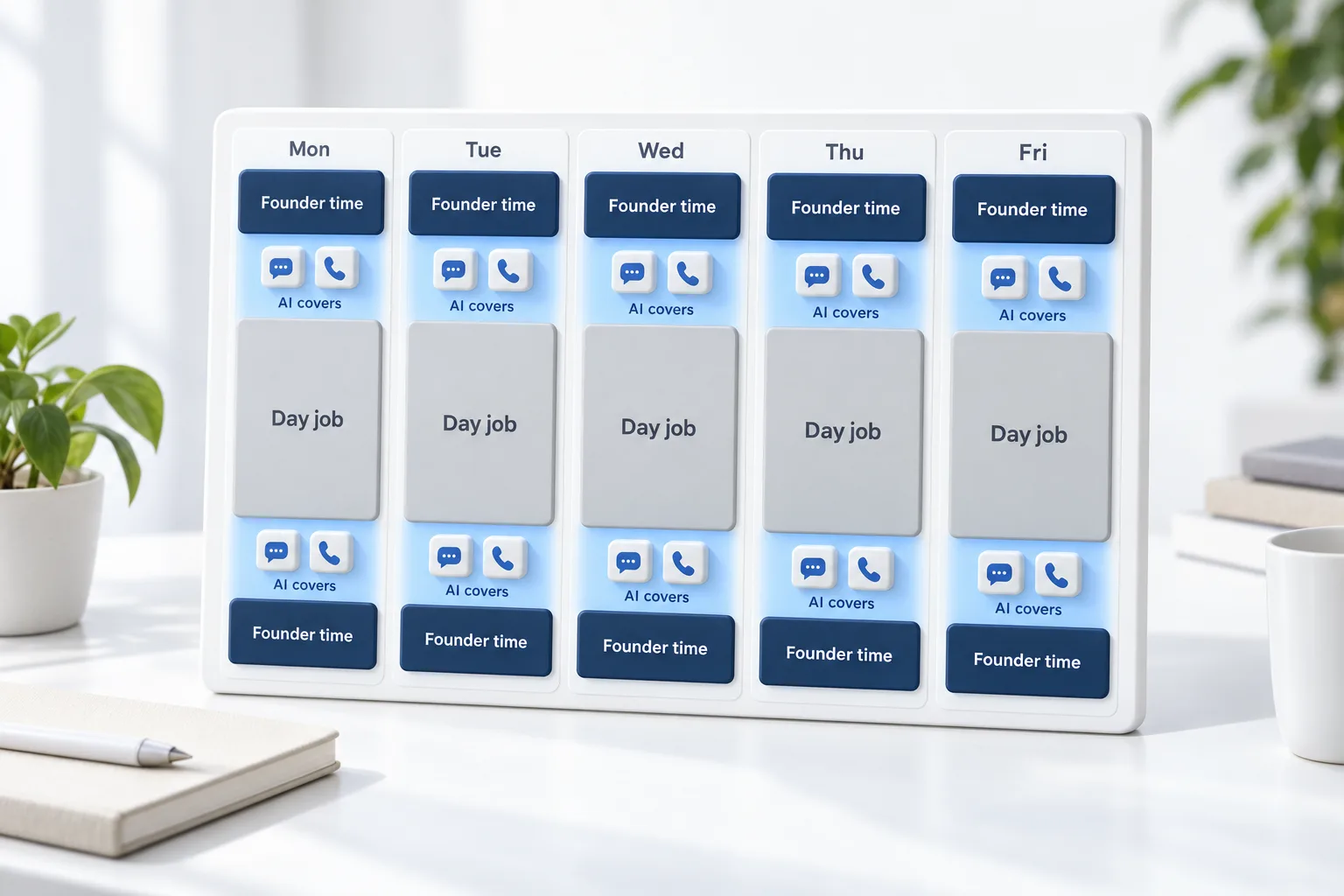
To become a Founder while working full time, protect a fixed weekly block of time, start with a simple service you can deliver around your job, let AI answer and follow up during work hours, check your employment agreement for conflicts and set a clear switch point, such as a revenue level held for several months, before you leave.
The plan
How do you make limited hours count?
- Block the same evenings or weekend hours every week.
- Pick a service you can deliver in those hours.
- Set up an AI receptionist and follow up so leads are handled while you work.
- Use templates and snapshots to cut build time.
- Track revenue and hours weekly.
When to switch
When should you leave your job?
Decide before you start what has to be true for you to leave: a monthly revenue level held for several months, enough savings to cover a runway and a pipeline of work. Deciding in advance keeps the choice rational.

The job is not the obstacle. It is the runway. Use it.
Choosing
Which kind of business fits around a job?
Not every business can be built in the evenings. The ones that work share a few traits.
- Delivery does not need you at fixed hours. Building an AI receptionist or a follow up system can happen at night. Sitting in a client's office at ten in the morning cannot.
- Customers can be reached outside work hours. Email, messages and short calls at lunch or after five.
- The work repeats. One system delivered to several similar clients, so each new one takes less time.
- It does not compete with your employer. Different customers, a different service and your own equipment.
The services on the AI business ideas for beginners page fit this pattern, because the build is done once and the system then runs with little attention.
While you work
How does AI cover the hours you are at work?
The hard part of a side business is not the building. It is the hours each day when you cannot answer. A lead who calls at eleven and reaches voicemail may call someone else.
This is where AI agents earn their place. On HighLevel, Voice AI answers your business line, explains what you do and books a call for the evening. Conversation AI replies to chat and text. A workflow sends follow ups on schedule. When you finish work, you find booked appointments and a record of each conversation instead of missed calls.
Set clear expectations in those conversations. Have the agent offer evening or weekend times and say when a person will reply. Customers accept a delay they were told about. The AI receptionist setup guide covers the build, and the how Founders use AI agents page covers the other jobs to hand over.
What goes wrong
What problems come up when you build on the side?
- Energy, not time. Two tired hours produce less than one fresh one. Use your best hours of the week for selling.
- Scope creep. A client asks for a little more each week. Fixed scope in writing protects your evenings.
- Blurred lines. Doing business tasks on work time or work equipment puts your job at risk. Keep them apart.
- No finish line. Without a switch point, the side business stays a side business. Review progress against it monthly.
Go at a pace you can hold for a year. A steady few hours every week beats a burst that ends in a month. The first 90 days plan gives those hours a structure, and the Founder time audit shows where they go.
If the job is your only business experience so far, becoming a Founder with no experience shows how to turn what you know into a first offer, and the Founder hub maps the rest of the path. When you are ready to build, start the 30 day GoHighLevel trial through Michael's link, use the GoHighLevel plan comparison to pick a starting plan, and read the Founder Plan FAQ before you move up.
Questions
Common questions.
Can I start a business while working full time?
Yes. Most Founders start part time and switch when the business proves itself. Keep your job for the income, give the business a fixed block of hours each week and choose a service you can deliver around your schedule. Check your employment agreement first so the side business does not create a conflict.
How many hours do I need?
A consistent weekly block matters more than the total. Ten focused hours is a real start, as long as they go to selling and delivering and not to logos or planning. Put the block on your calendar, protect it like a client meeting and let AI answer inquiries during the hours you are at work.
When should I quit my job?
Quit at a switch point you set in advance, not on a bad day at work. A common switch point is a revenue level held for several months, plus savings that cover your living costs for a period you are comfortable with. Write the numbers down now, so the decision is already made when you reach them.
Do I have to tell my employer about my business?
Read your employment agreement and company policy. Some require disclosure or approval for outside work, and some restrict work for competitors or use of company time and equipment. If anything is unclear, ask an attorney before you start, and keep the business on your own devices and your own hours.
What kind of business is easiest to run alongside a job?
A service you can build in your own hours that then runs with little attention, such as an AI receptionist or automated follow up for local businesses. The setup happens in the evening, and the system works during the day without you. Avoid offers that need you on live calls during work hours.
How do I handle client calls during work hours?
Let an AI agent answer and book calls into times you are free, such as lunch, evenings or weekends. Tell clients up front when you are available, and keep support in writing where you can, so replies do not depend on you picking up the phone during your work day.
Next step
See it in your own account. Thirty days, every feature.
Start a trial, build the first system and test it before the first invoice. Usage fees for phone, SMS, email and AI can apply during the trial.
HighLevel has three plans at a flat monthly price, each with unlimited users and contacts. See what each one includes and what it costs.
Compare the PlansStarter, Unlimited and Founder