
Real
Validation
- They describe the problem without prompting
- They already pay to solve it
- They agree to pay for a pilot
- They refer others
Home/Founders/Validate a business idea
Founders · Validation
Validation is the cheapest insurance a Founder can buy. The goal is not to hear that people like your idea. It is to find out whether they will pay to solve the problem. Here is a method that gets you a real answer in weeks.
The short answer
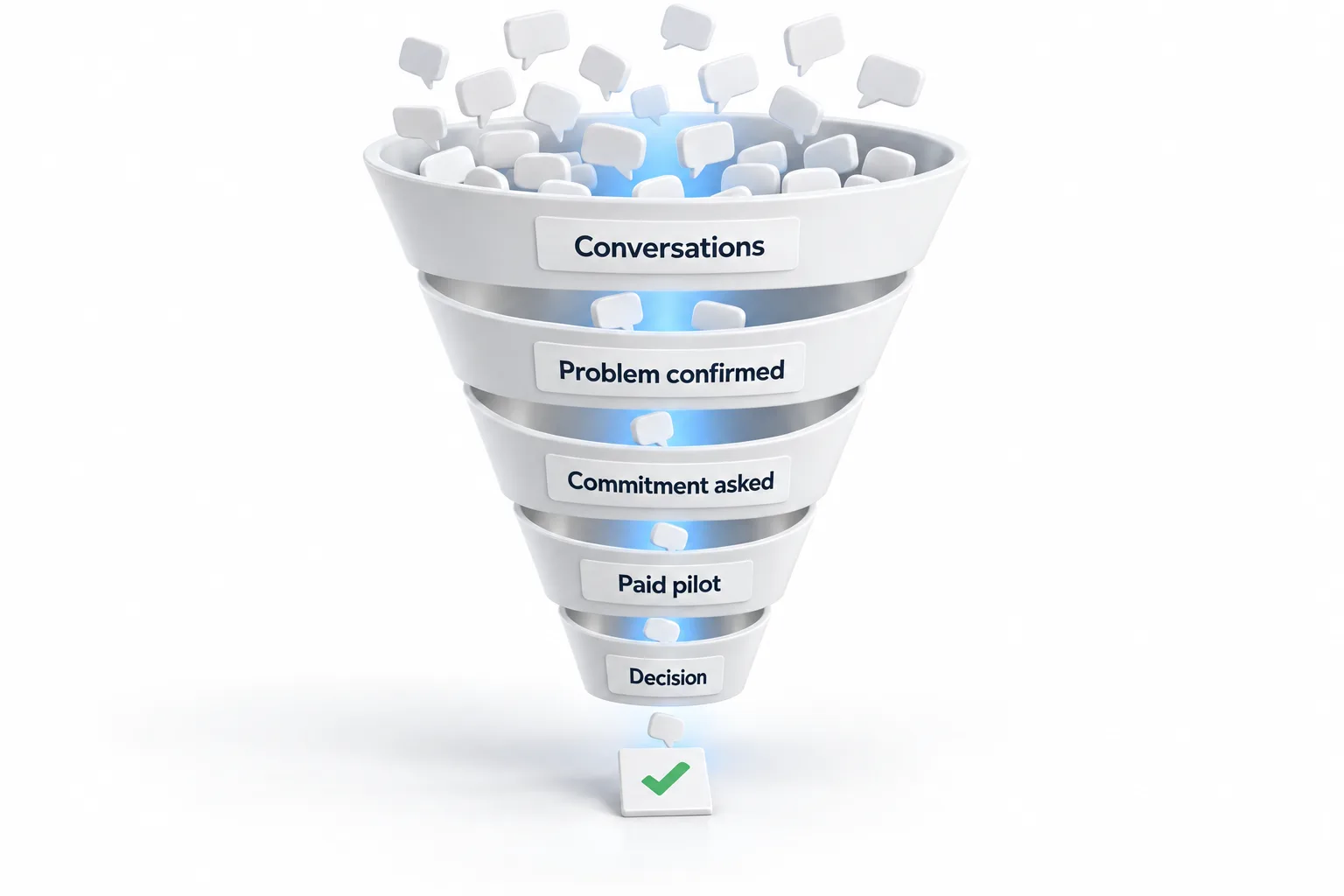
To validate a business idea: talk to about twenty potential buyers about the problem, not your solution; check whether they already spend money on it; ask for a commitment such as a deposit, a letter of intent or a paid pilot; deliver a small pilot; and decide using criteria you set in advance. Compliments are not validation; payments are.
The method
Signals
Real
Polite

The only validation I trust is money changing hands. Everything else is encouragement.
Step two in detail
The goal is to learn how the person deals with the problem today. You are not presenting anything. If you describe your idea first, most people will be kind about it, and kindness tells you nothing.
Take notes in their exact words. Those words become your offer and your marketing later. If several people describe the same problem the same way without being led, you have found something.
Step five in detail
A pilot is a small, time limited version of the service that someone pays for. Payment is the point. It turns interest into a decision.
For an AI service, a pilot might be an AI receptionist on one phone line for a few weeks. The client sees it work in their own business, and you see what real callers ask. The how to start an AI business page covers building the system you would pilot.
After the test
This is why you write criteria in advance. Without them, it is easy to explain away a weak result because you like the idea.
A no is a good outcome when it comes early. It costs a few weeks instead of a year. Most Founders go through more than one round before something holds. When it does, the first 90 days plan is the next thing to follow, and Founder mistakes lists what to avoid as you start to build. If you need a fresh problem to test, see how to find a business idea with AI.
If you are still choosing what to test, AI business ideas and AI business ideas for beginners list starting points, and the Founder hub shows where validation sits in the path.
When a pilot needs a working system, the GoHighLevel 30 day trial through Michael's link gives you an account to build it in. GoHighLevel plans compared shows the plan options, and the Founder Plan FAQ covers the top plan.
Questions
To validate a business idea, talk to potential buyers about the problem, check whether they already spend money on it, ask for a commitment such as a deposit or a paid pilot, and deliver that pilot. Decide using criteria you set in advance. Compliments are not validation. Payments are.
About twenty conversations is a good start. By then the same problems and objections repeat, and you can see a pattern instead of one person's opinion. If twenty buyers describe the problem differently or do not spend money on it today, that is a result too, and a useful one.
Not by itself. A survey can show which problems come up most, but answering a question costs the buyer nothing. Commitments and payments are stronger signals. Use a survey to choose who to talk to, then ask those people for a deposit, a signed agreement or a paid pilot.
A commitment that costs the buyer something: a payment, a deposit, a signed agreement or a paid pilot. Interest and compliments do not count, however warm they sound. The amount matters less than the fact that saying yes cost the buyer something real.
Usually not. Describe the offer and ask for a commitment first. For an AI service, a simple working demo can help, but keep it small until someone pays. The demo is there to make the offer clear, not to prove you can build.
Treat it as a no for now. Ask what would have to change for them to start, then adjust the offer or move to a different buyer. A polite yes without payment usually means the problem is not painful enough yet.
Next step
Start a trial, build the first system and test it before the first invoice. Usage fees for phone, SMS, email and AI can apply during the trial.
HighLevel has three plans at a flat monthly price, each with unlimited users and contacts. See what each one includes and what it costs.
Compare the PlansStarter, Unlimited and Founder