Home/HighLevel/AI/What is an AI agent
HighLevel AI
What Is an AI Agent? A Plain Answer With Everyday Business Examples
An AI agent is software that works toward a goal and takes real actions to reach it. Here is the plain answer, how an agent differs from a chatbot and from a workflow, three everyday business examples, what agents cannot do and the AI agents inside GoHighLevel.
Sign up through Michael's link and the CRM Pros team gets you set up in your first 7 days, with weekly calls and the community included.
The short answer
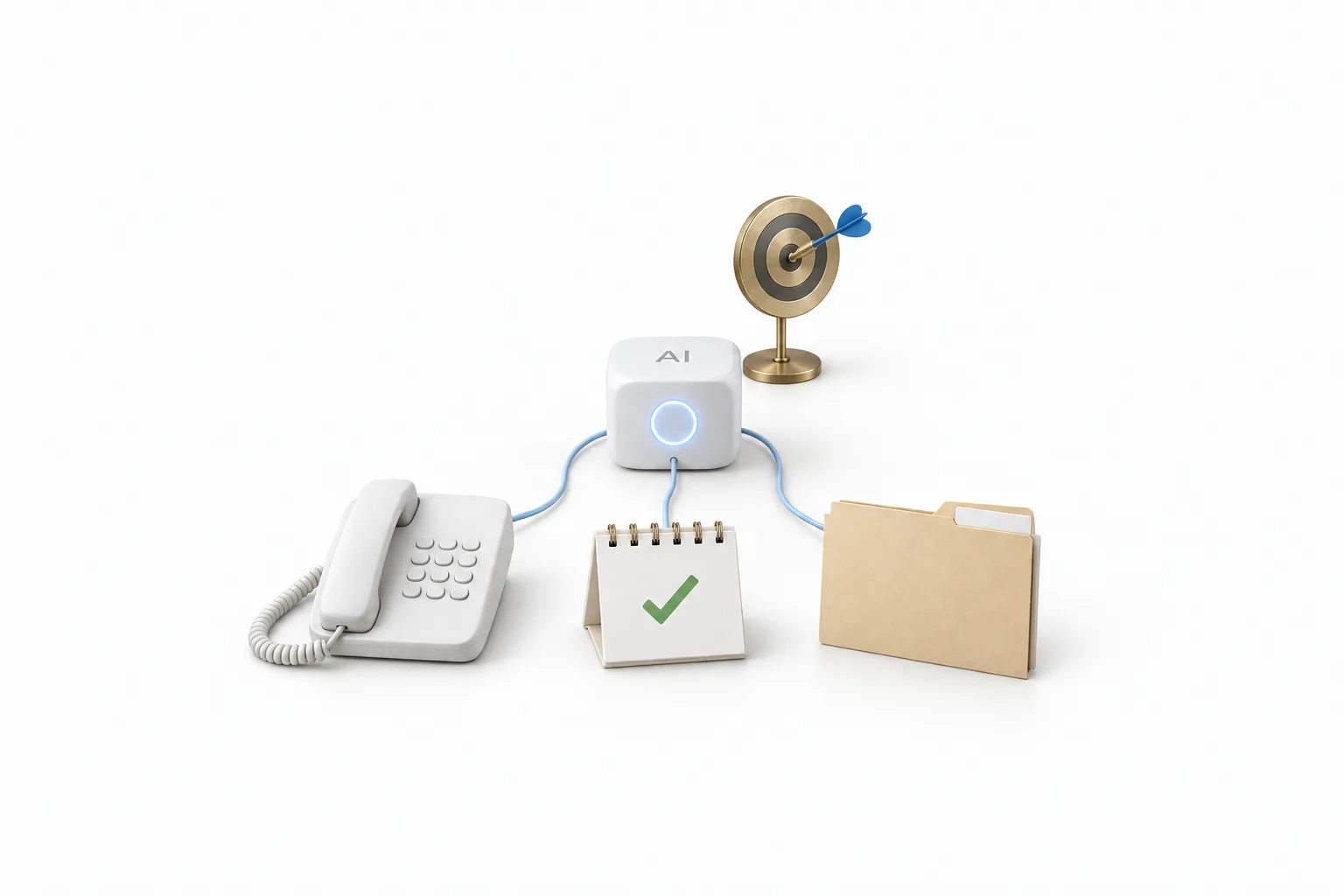
An AI agent is software that uses an AI model to work toward a goal you set. It reads the situation, decides the next step and takes real actions with the tools you allow, such as answering a call, booking an appointment or updating a record. GoHighLevel agents include Voice AI and Conversation AI.
Michael is a sponsored HighLevel affiliate. Links to HighLevel use his partner link at no extra cost to you. HighLevel prices and product facts on this page come from HighLevel's own pricing page and help center, checked November 2026.
Key takeaways
- An AI agent works toward a goal using instructions, knowledge, tools and limits. It reads, decides, acts and checks.
- A chatbot replies. A workflow repeats fixed steps. An AI agent handles the parts that change.
- The usual first agents answer the phone, reply to messages and handle routine tasks behind the scenes.
- AI agents do not replace judgment, relationships or ownership of the outcome.
- GoHighLevel has six: Voice AI, Conversation AI, Reviews AI, Managed Agents, the AI Agent workflow action and Ask AI.
Build your first agent in your own accountThe agents on this page run inside HighLevel. Start through Michael's link and build one with the team on the weekly calls.
Start a 30 Day TrialSetup included. We build it with you.Upgrade My PlanOn HighLevel? Unlock your benefits.What is an AI agent, in plain language?
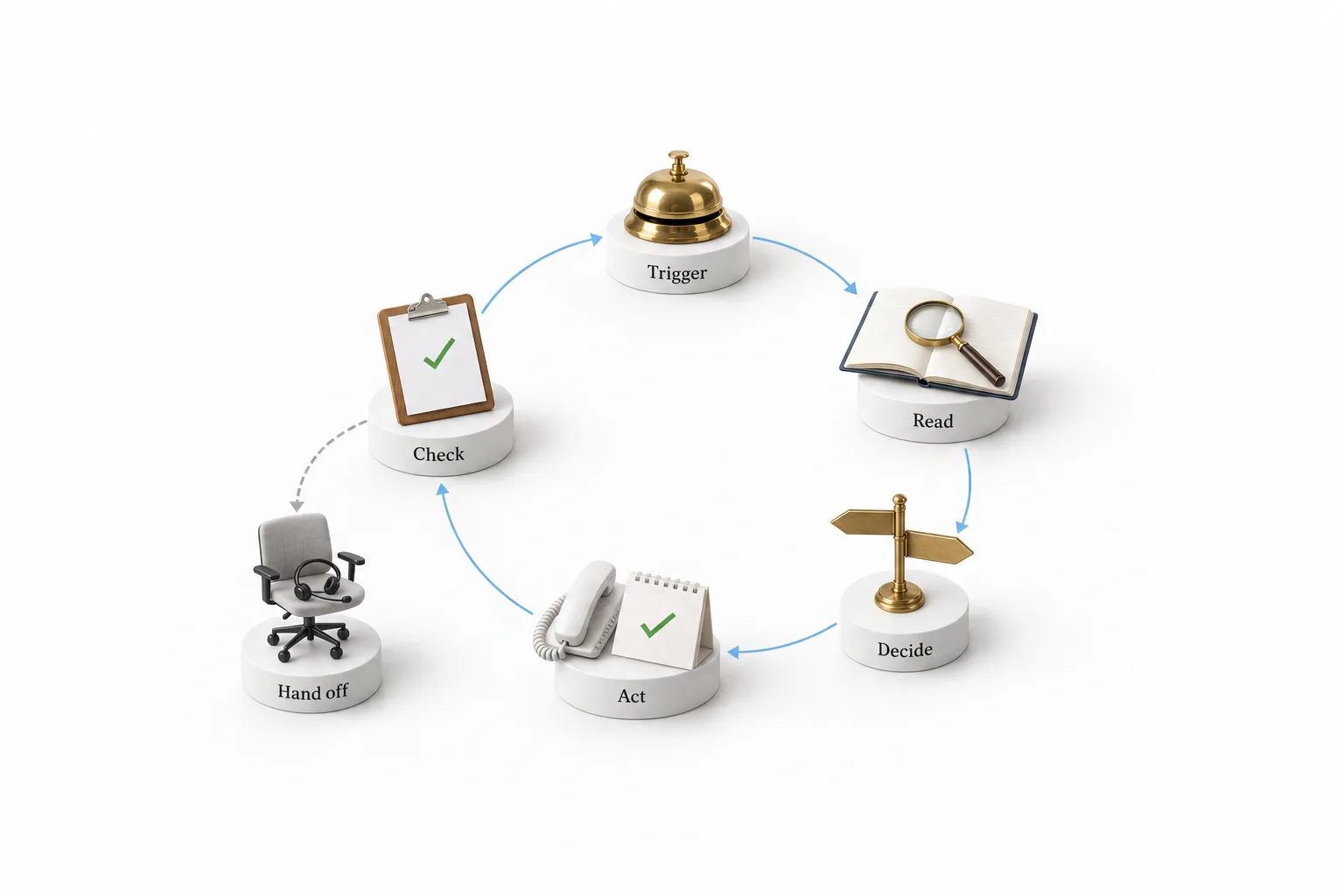
An AI agent is software that is given a goal and the means to reach it. You tell it what the job is. It reads what is in front of it, decides what to do next, does it and then looks at the result. It repeats that loop of read, decide, act and check until the job is done.
Three things separate an agent from ordinary software. It understands plain language. It can use tools, so it can check a calendar, book a slot, send a text or update a contact record. And it makes small decisions on its own, inside limits you set.
Most business agents are built from the same four parts.
- Instructions. Who the agent is, what the job is and what it must never do.
- Knowledge. Your services, prices, hours and policies, so its answers come from your business and not from a guess.
- Tools. The actions it is allowed to take, such as booking, texting or creating a task.
- Limits. The point where it stops and hands the conversation to a person.
I have worked full time in AI for about four years. The agents that hold up have a narrow job and clear limits.
How an AI agent handles one request
- Something starts it. A call comes in, a message arrives or a new lead is created.
- It reads the situation. The request, the contact record and the knowledge you gave it.
- It decides the next step. Answer the question, ask for a missing detail or offer a time.
- It acts with a tool. It books the appointment, sends the confirmation or updates the record.
- It checks and closes. It stops when the job is done, or hands off to a person.
How is an AI agent different from a chatbot?
A chatbot can only reply, while an AI agent replies and takes action.
A traditional chatbot follows a script or a menu. It can answer a common question and collect a name and a phone number. Outside the script, it gets stuck. It usually cannot change anything in your systems.
An AI agent works toward an outcome. Ask it for an appointment on Thursday afternoon and it checks the calendar, offers the open times, books the one you pick and sends the confirmation. The conversation is the visible part. The work gets done through the tools.
The word chatbot is used loosely, and some products sold as chatbots can now take actions too. So ask one question. Can it take an action in your business, or can it only reply?
How is an AI agent different from a workflow?
A workflow repeats fixed steps that you design in advance, while an AI agent decides what to do when the situation changes. A typical workflow reads like this: when a form is submitted, send this text, wait a day, then send this email. It does the same thing every time, which is what you want for work that never changes.
An AI agent is for the parts that do change. A workflow cannot read a messy reply and work out what the person meant. An agent can. A workflow is predictable. An agent is flexible and needs more supervision.
The two work best together. The workflow carries the fixed steps and calls an agent at the one step that needs judgment, such as reading an incoming message and deciding whether it is a sales question or a support request.
| Question | Chatbot | Workflow | AI agent |
|---|---|---|---|
| What does it follow? | A script or a menu | Steps you set in advance | A goal, instructions and limits |
| Does it understand plain language? | Only what the script expects | No, it reacts to triggers | Yes |
| Can it take actions? | Rarely | Yes, the same ones every time | Yes, and it chooses which one fits |
| How does it handle the unexpected? | Poorly | It does not | Within its limits, then it hands off |
| What is it best for? | Simple, common questions | Repeatable steps that never change | Conversations and tasks that vary |
What are three everyday AI agent examples in a business?
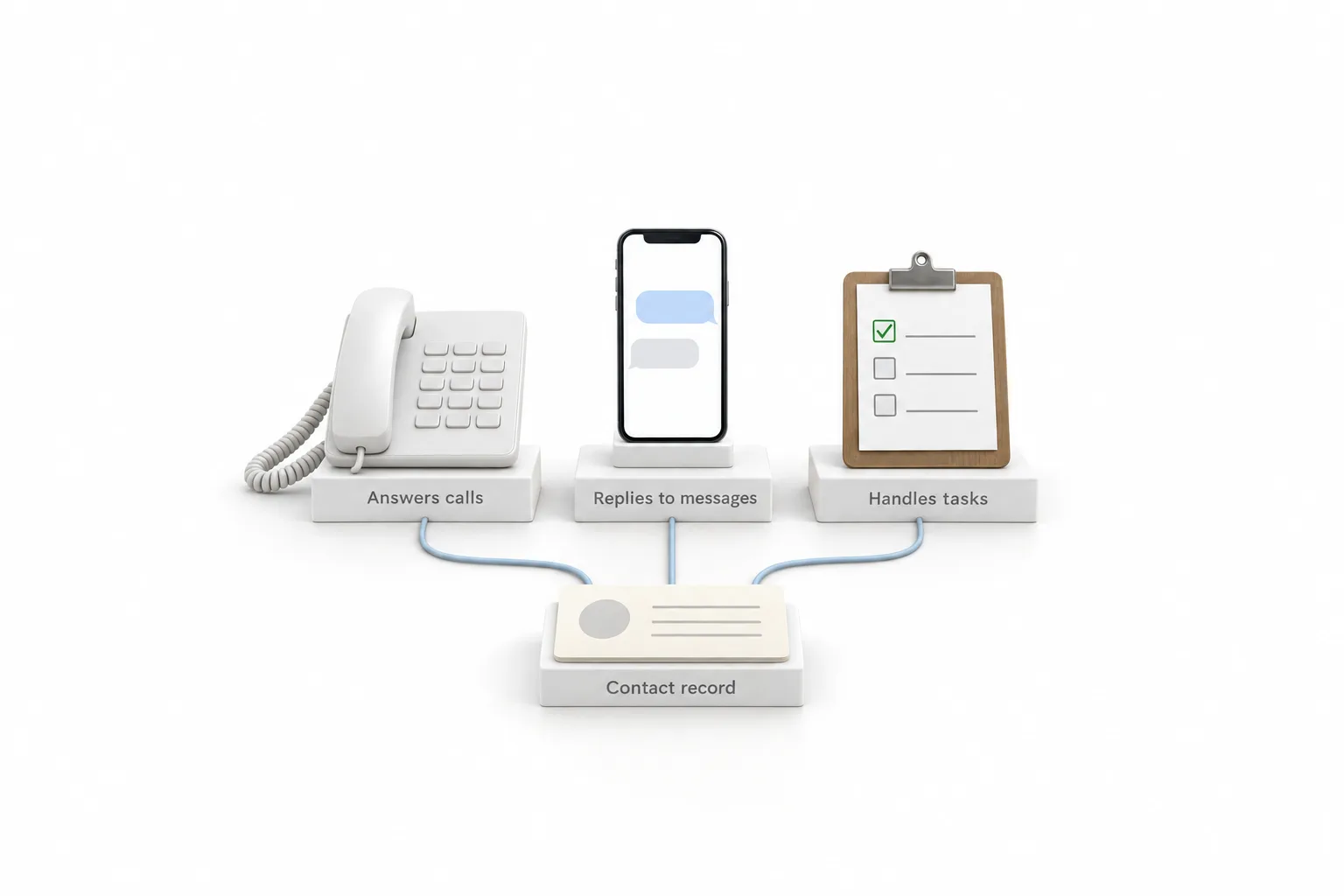
Three everyday AI agent examples are an agent that answers the phone, an agent that replies to messages and an agent that handles routine tasks behind the scenes. Each one is a narrow job that used to depend on someone being free at the right moment.
An agent that answers the phone
A customer calls while you are with another customer. The agent answers, asks what they need, answers common questions from your business information, books the visit on your calendar and sends a confirmation. If the caller asks for a person, it transfers the call.
An agent that replies to messages
A lead sends a text or a website chat message at nine at night. The agent replies right away, answers the question, asks the two or three things you need to know and offers a time. The whole exchange is saved on the contact record for you to read in the morning.
An agent that works behind the scenes
A new lead comes in. Nobody talks to this agent. It reads the lead, writes a short brief for the owner and creates the first follow up task. People skip this kind of housekeeping when the day gets busy.
For a wider view of how owners put these to work, see how Founders use AI agents.
Build it with us
Put this to work in your own HighLevel.
HighLevel is the AI powered business operating system this site is built around. Start through Michael's link and you are not on your own: the CRM Pros team and nearly 4,000 affiliates are already building the same way.
- Setup help in your first 7 days from the CRM Pros team
- One onboarding call, then three live calls every week
- The affiliate community, snapshots, templates and email swipes
- Four apps included: Prompt, Demo, A2P and Sales On Demand
Already on HighLevel? Upgrade through Michael's link for the same bonuses.
What can an AI agent not do?
An AI agent cannot use judgment the way you do, know what you never told it, fix a broken process or own the outcome. Its strength is repeatable work with a clear finish line.
- It does not use judgment the way you do. It will not negotiate a special deal, decide your prices or sense that a long time customer is upset.
- It does not know what you never told it. An agent answers from the knowledge you give it. Leave a gap and it may guess, so the knowledge comes first.
- It does not fix a broken process. If your follow up is unclear today, an agent will run the unclear version faster.
- It does not own the outcome. You do. Every customer facing agent needs a rule for when a person takes over.
- It does not remove the rules. Texting and calling customers still carry registration and consent requirements.
The full list for HighLevel is on what GoHighLevel AI agents can and cannot do.
My rule of thumb. Give an agent the jobs you would hand a new front desk hire on day one. Keep the jobs you would give a manager.
Which AI agents are inside GoHighLevel?
HighLevel, which most people search for as GoHighLevel or Go High Level, has six AI agents: Voice AI, Conversation AI, Reviews AI, Managed Agents, the AI Agent workflow action and Ask AI. The first three talk to your customers. The last three work for your team. All six run inside one account.
| Agent | Works with | What it does |
|---|---|---|
| Voice AI | Customers, by phone | Answers calls, qualifies, books and transfers |
| Conversation AI | Customers, by SMS, email, web chat, WhatsApp, Facebook and Instagram | Answers questions, qualifies and books |
| Reviews AI | Reviewers | Suggests or posts replies to reviews |
| Managed Agents | Your team | Run tasks when a CRM event happens, such as a new contact or a new opportunity |
| AI Agent workflow action | Your team | Plans and completes a multi step task inside a workflow |
| Ask AI | You | Creates content, finds data and takes actions in the app when you ask |
Custom agents are built in Agent Studio, where every new agent is created as a Managed Agent that you describe in plain language. The Agent Studio guide explains how that works, and the GoHighLevel AI agents page compares all six side by side. Everything else sits under the HighLevel AI hub.
On cost, Ask AI is free for agency users under fair use. The agents that work on a business's behalf are paid, through an AI Employee plan per subaccount or pay per use. As of November 2026 the AI Employee plans that include agents are Growth at $50 a month and Unlimited at $97 a month, per subaccount, on top of the platform plan. Phone, text and email charges are billed separately. GoHighLevel pricing lists every plan and the date it was last checked.
How do you set up your first AI agent?
Set up your first AI agent by giving it one job on one channel, then adding knowledge, instructions and a handoff rule before you test it.
- Write the job in one sentence. For example: answer website chat questions and book estimates.
- Build the knowledge first. Services, prices, hours, policies and the questions people ask every day.
- Write the instructions. Who the agent is, what it should do and what it must never do.
- Set the handoff. Decide exactly when a person takes over.
- Test before customers see it. Run scripted conversations and fix what fails.
- Read the transcripts. Every day for the first week. Then add the next job.
In HighLevel, the quickest first build is a text and chat agent, and the Conversation AI setup guide walks through it step by step. You can build and test your first agent during the 30 day trial through my link. HighLevel's standard trial is 14 days. Usage fees for phone, SMS, email and AI can apply during the trial.
Questions people ask
Frequently asked questions.
What is an AI agent?
An AI agent is software that uses an AI model to work toward a goal you set. It reads the situation, decides the next step and takes real actions with the tools you allow, such as answering a call, booking an appointment or updating a record.
What are AI agents?
AI agents are software programs that complete tasks for a person or a business instead of only answering questions. Each one has a job, instructions, knowledge to answer from and tools it can use. Common business agents answer calls, reply to messages and book appointments.
What are some AI agent examples?
Three everyday AI agent examples are a phone agent that answers calls and books appointments, a messaging agent that replies to texts and website chats and qualifies leads, and a back office agent that writes a brief and creates a follow up task when a new lead arrives. In GoHighLevel these are Voice AI, Conversation AI and Managed Agents.
What is the difference between an AI agent and a chatbot?
A chatbot follows a script and can only reply. An AI agent works toward an outcome and can take actions, such as checking a calendar, booking a time and sending a confirmation. The test is whether it can act or only answer.
Does GoHighLevel have AI agents?
Yes. GoHighLevel has Voice AI for phone calls, Conversation AI for text, chat, email and social messages, Reviews AI for review replies, Managed Agents that run tasks on CRM events, the AI Agent workflow action and Ask AI, the in app copilot. The first three talk to customers. The last three work for your team.
How much do AI agents cost in GoHighLevel?
Ask AI is free for agency users under fair use. Customer facing agents such as Voice AI and Conversation AI are paid, through an AI Employee plan per subaccount or pay per use. As of November 2026, the AI Employee plans that include agents are Growth at $50 a month and Unlimited at $97 a month per subaccount. Phone, text and email charges are billed separately.
Sources
- HighLevel help center, including its comparison of Managed Agents, Conversation AI and Ask AI, as summarized on the GoHighLevel AI agents page. Checked November 2026.
- HighLevel's AI Product Pricing article, as recorded on GoHighLevel AI pricing. Checked November 2026.

About the author
Michael Reimer
Michael Reimer is an international keynote speaker and AI advisor and the Founder of CRM Pros, the HighLevel focused agency, affiliate community and training organization behind nearly 4,000 affiliates. He is a HighLevel Commander and Certified Admin and the author of Starting an AI Agency.
Michael Reimer is an AI architect, global keynote speaker, HighLevel Commander and the Founder of CRM Pros. Read his background, awards and credentials.
About MichaelBackground, awards, credentialsKeep reading
Related articles.

What Is an AI Employee? The HighLevel AI Employee Explained for Founders
What an AI employee is, what the GoHighLevel AI Employee includes, what it costs, what it does not replace, and a 30 day rollout plan.

HighLevel AI Explained: Conversation AI, Voice AI, Workflow AI, AI Studio and Ask AI
HighLevel AI explained in plain language: what Conversation AI, Voice AI, Workflow AI, AI Studio and Ask AI each do, one real use case for each, how they connect in one workflow, what is included versus usage billed, and where to start.

AI Receptionist for Small Business: How Voice AI Answers, Qualifies and Books, and How to Build One in HighLevel
What an AI receptionist does for a small business in 2026, what it costs next to a human or an answering service, how Voice AI in HighLevel answers, qualifies and books, and how to build and test one.