
Home/HighLevel/Agency/Agency SOPs
GoHighLevel agency · Systems
Agency SOPs. Write it once, do it right every time.
Standard operating procedures turn what is in your head into something a team can follow. Start with the processes that happen for every client, write them plainly, and keep them where the work happens.

The short answer
Every agency should document seven SOPs, sales, onboarding, launch checklist, QA testing, support, monthly reporting and offboarding, each written as numbered steps that a new hire can follow alone, with simple screenshots, a named owner and a quarterly review date. Store them next to the work, for example as tasks or documents in GoHighLevel.
Michael is a sponsored HighLevel affiliate. Links to HighLevel use his partner link at no extra cost to you. HighLevel prices and product facts on this page come from HighLevel's own pricing page and help center, checked on the date above.
Core
Which seven SOPs should every agency document?
| SOP | Covers |
|---|---|
| Sales | From booked call to signed |
| Onboarding | Welcome to kickoff |
| Launch checklist | Snapshot, phone, A2P, domain, calendar |
| QA testing | Every workflow tested before go live |
| Support | How requests come in and get answered |
| Monthly reporting | Numbers, call and follow up |
| Offboarding | Data export and access removal |
Write
How do you write an SOP a new hire can follow?
- Do the task yourself and record your screen.
- Write each step as one short sentence.
- Add a screenshot for any step with a choice.
- Have someone else follow it and fix what confused them.
- Name an owner and a review date.
Format
What goes into a good agency SOP?
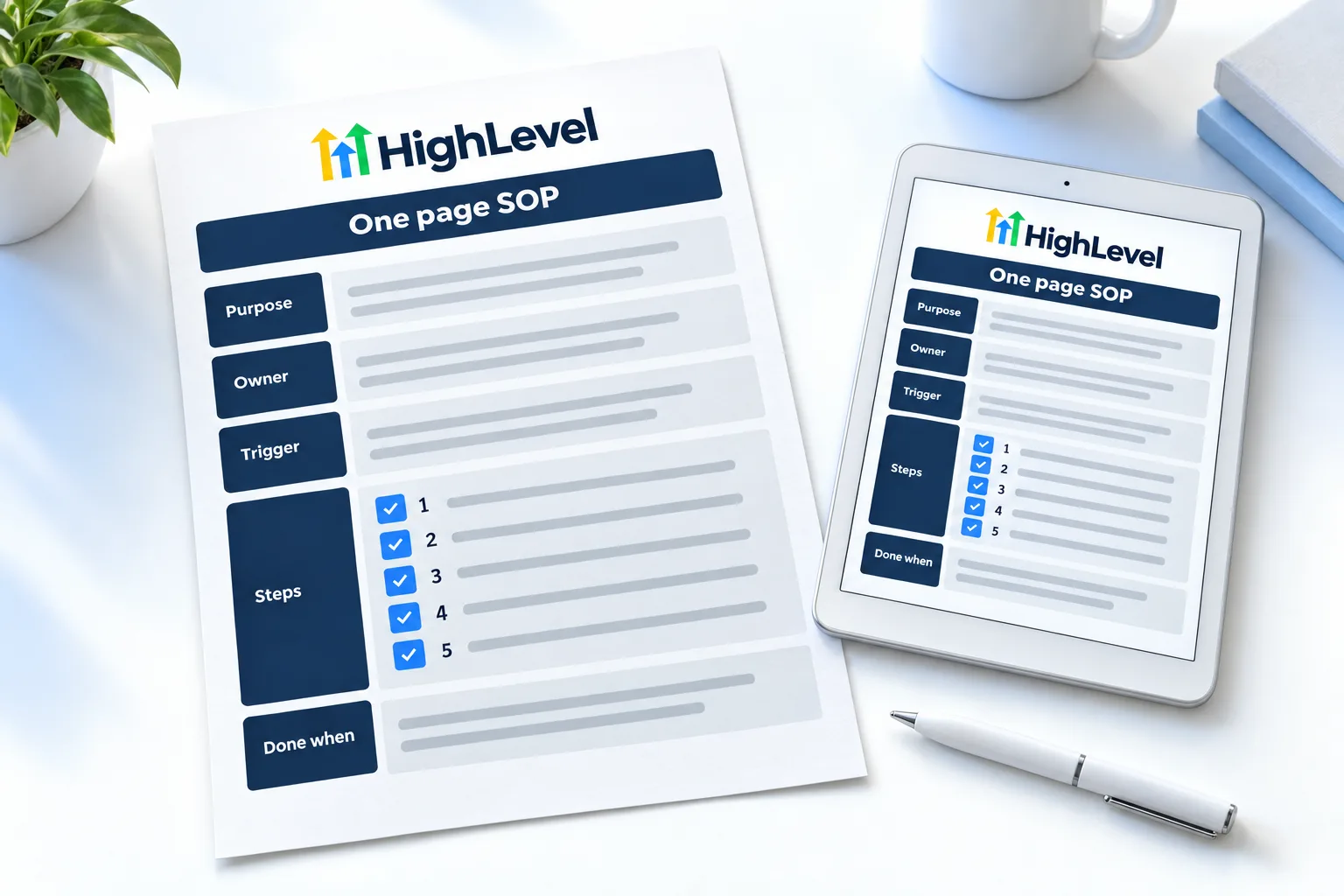
A standard operating procedure does not need to be long. It needs to be complete enough that someone who has never done the task can finish it without asking you anything. One page usually does it.
| Part | What it says |
|---|---|
| Purpose | Why this task exists, in one sentence |
| Owner | The one person responsible for keeping it current |
| Trigger | What starts the task, such as a signed contract |
| Steps | Numbered, one action per step, with a screenshot where there is a choice |
| Done when | How the person knows the task is finished and correct |
The last line is the one most people forget. "Load the snapshot" is a step. "The client's subaccount shows the pipeline, the calendar and the draft workflows, and every custom value is filled in" is a finish line. Without it, a new hire stops when the steps run out, not when the job is right.
Write for the person who will read it. I keep the guides for my own VA team very basic, one click per step, because the reader should never have to guess. If your SOP assumes knowledge, add the missing step.
Example
What does a client launch checklist look like in practice?
The launch checklist is the SOP you will use most, so here is the shape of one for a GoHighLevel client setup. Adjust the details to your own offer.
- Create the client subaccount and load your snapshot.
- Fill in every custom value: business name, phone, hours, booking link, review link.
- Set up the phone number and start A2P registration with the legal details from the intake form.
- Connect the client's domain and sending domain.
- Connect the calendar and Google Business Profile with the owner's login.
- Add the client's users with only the permissions they need.
- Test every workflow with your own contact while it is still in draft, then publish.
- Turn on rebilling and confirm the first invoice is scheduled.
Two notes from experience. Keep workflows in draft inside the snapshot, so turning each one on is a deliberate step and nothing fires at a client's customers by accident. And remember that a snapshot cannot be unloaded once applied, so the checklist starts in the right subaccount or it starts over.
Upkeep
Where should SOPs live and how do you keep them current?
An SOP nobody can find is the same as no SOP. Keep them where the work is assigned. If you run tasks in HighLevel's project and task management, link the SOP in the task. If your team works from a shared drive, use one folder with one naming pattern and no copies.
Keeping them current is a habit, not a project. HighLevel moves menus and adds features often, so screenshots age quickly. Give each SOP one owner and a review date each quarter. More useful still, make it a rule that anyone who hits a step that no longer matches the screen fixes the document before they finish the task.
SOPs are also what make hiring possible. The hiring your first VA page starts from the same idea: write the steps first, then hand the job off. And when delivery is the thing holding you back, the scaling page explains why systems come before headcount.
SOPs matter most once delivery repeats, which is the point of the GoHighLevel agency path. As the client list grows, who should get the GoHighLevel Founder Plan helps you decide when to move up, with GoHighLevel plans compared, the Founder Plan, formerly Agency Pro page and HighLevel Founder Plan explained for the detail. You can build your first checklist as tasks during the GoHighLevel 30 day trial through Michael's link.

The best SOP test is a new hire following it without asking you a single question.
Questions
Common questions.
What SOPs does an agency need?
Seven: sales, onboarding, the launch checklist, QA testing, support, monthly reporting and offboarding. These are the processes that repeat for every client, so writing them down helps every time. Each SOP needs numbered steps, a named owner and a review date. Start with the one that goes wrong most often.
How detailed should an SOP be?
Detailed enough for a new hire to follow alone, without asking you a question. Write numbered steps in plain words, add a screenshot where a screen is confusing, and say what done looks like at the end. If someone gets stuck while following it, the SOP is missing a step.
Where should SOPs live?
Keep SOPs close to the work, such as tasks or documents in your CRM. A procedure in a folder nobody opens does not get followed. In HighLevel you can store them as documents or build the steps into task lists, so the process appears where the team already works.
How often should I update them?
Review each SOP quarterly and whenever the process changes. Give every SOP one owner who is responsible for keeping it current. HighLevel ships updates often, so screens and menus move. An out of date SOP is worse than none, because people stop trusting the rest of them.
What does SOP stand for?
Standard operating procedure. It is a written set of steps for a task that repeats, so anyone on the team can do it the same way. Agencies use them so quality does not depend on who happens to do the work that day.
Which SOP should I write first?
The client launch checklist. It repeats for every client and has the most steps that can go wrong. Write it the next time you launch a client, while you are doing the work, then follow it yourself on the launch after that and fix whatever was missing.
Should SOPs be written or video?
Both help. Record your screen once for context, then write numbered steps, because written steps are faster to follow and easier to update. Update the written steps first when something changes, and replace the video only when it would confuse people.
Next step
See it in your own account. Thirty days, every feature.
Start a trial, build the first system and test it before the first invoice. Usage fees for phone, SMS, email and AI can apply during the trial.
HighLevel has three plans at a flat monthly price, each with unlimited users and contacts. See what each one includes and what it costs.
Compare the PlansStarter, Unlimited and Founder