
01
The outcome
What the company is for, who it serves and what it will not do.
Home/Founders/What is an AI Founder
Founders · Definition
An AI Founder is not someone who uses ChatGPT. It is a Founder who builds a company where AI agents and automation do real, recurring work, and who spends their own time on the decisions only a Founder can make. Here is the role, how it differs from a traditional Founder and how to become one.
The short answer
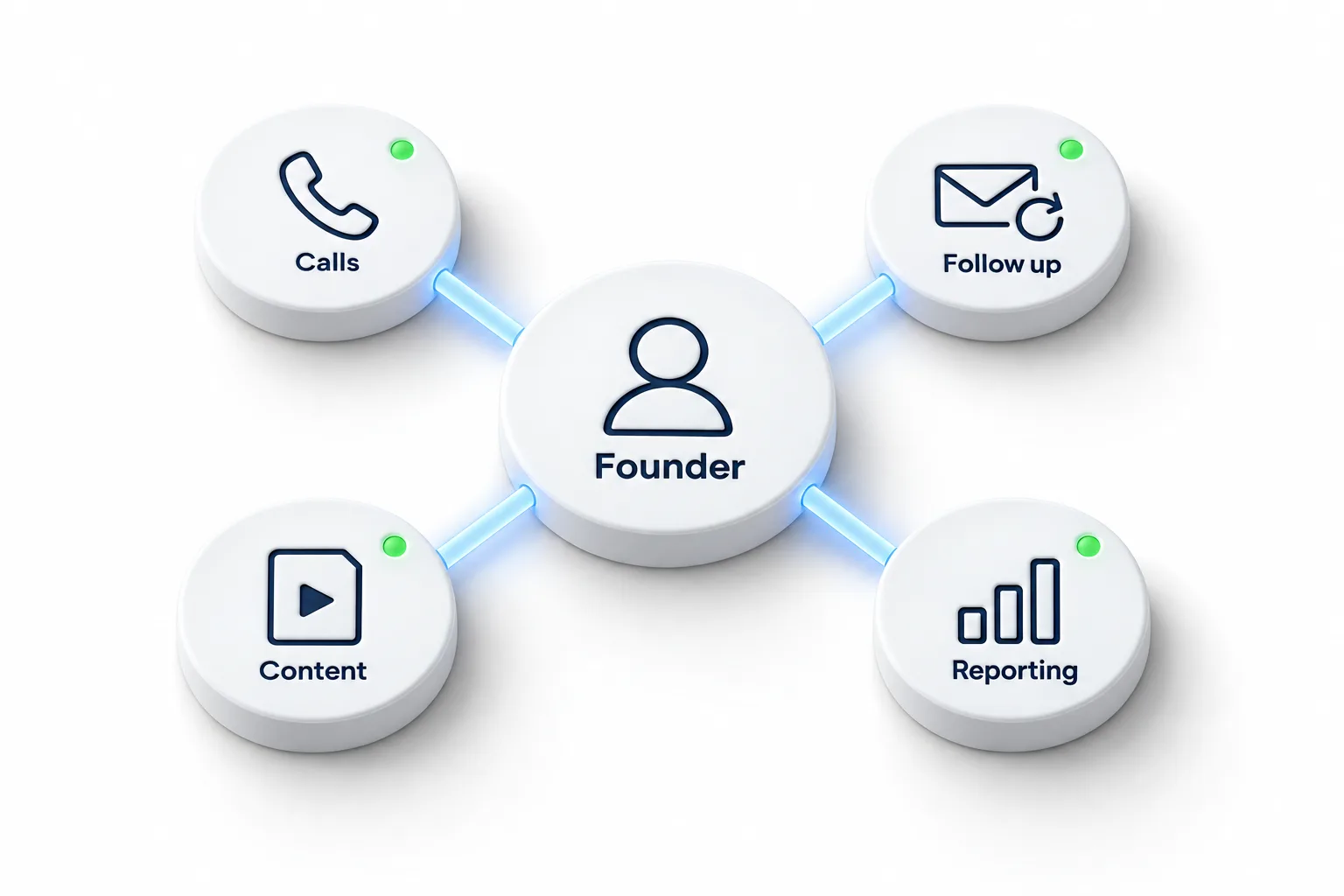
An AI Founder is a Founder who designs a business so that AI agents and automation handle recurring work, such as answering calls and messages, following up with leads, producing content and reporting. The Founder owns the outcome: what the company sells, which systems run it and which numbers matter. Capacity comes from systems before headcount.
The role
01
What the company is for, who it serves and what it will not do.
02
A named system with an owner, human or AI, behind every repeated task.
03
A short weekly review of the few numbers that show whether the systems work.
The difference
| Traditional Founder | AI Founder | |
|---|---|---|
| Adds capacity by | Hiring | Building systems first, hiring for judgment |
| First hire | An assistant or receptionist | An AI agent for the front door |
| Time goes to | Doing and supervising | Deciding, selling and improving systems |
| Reporting | Monthly, by hand | Weekly, automated |
Become one
The how to become an AI Founder page goes deeper on each step.

I have spent about four years full time building with AI, and the Founders who win are not the ones with the most tools. They are the ones who decided what the systems are for.
Clearing it up
The term gets stretched, so it helps to say what it does not mean.
The last point is the one people miss. Being an AI Founder describes how you run a company, not what the company sells. Some AI Founders sell AI systems to others. Many simply use them to run a business in an ordinary industry with faster response and less routine work.
An example
Take a small home service company. The traditional setup has an owner, a few technicians and an office person who answers the phone, books jobs and chases estimates. When the office person is at lunch or it is after six, calls go to voicemail.
The AI Founder version changes the front office. A Voice AI agent answers every call and books the estimate. Conversation AI handles website chat and texts. A workflow follows up on open estimates and asks for a review after each job. The owner checks the numbers on Monday and adjusts.
The technicians still do the work. The owner still decides prices and handles the difficult customer. What changed is that nothing waits on a person being free to pick up the phone. On HighLevel this runs in one account. The page on how Founders use AI agents lists the jobs, and the AI receptionist guide covers the phone side in depth.
Honest limits
The role only works if the Founder keeps the parts that need a person.
AI agents can be wrong, and they do not know when they are. A weekly review of real conversations is part of the job, along with consent and disclosure for calls and texts. The page on what AI can and cannot do goes through the limits, and the year of the AI Founder explains why this way of working is spreading now. If you plan to sell AI systems to others on GoHighLevel, who should get the Founder Plan covers the plan built for that.
The Founder hub explains how the role connects to HighLevel's top plan, and the Founder Plan FAQ answers what that plan includes. To build your first system, start the GoHighLevel 30 day trial through Michael's link, and use GoHighLevel plans compared to choose where to begin.
Questions
An AI Founder is a Founder who builds a business where AI agents and automation do recurring work, while the Founder owns the outcome, the systems and the numbers. The recurring work includes answering calls and messages, following up with leads, producing content and reporting. Capacity comes from systems before it comes from headcount.
No. Platforms like HighLevel let Founders build AI systems without code. You describe what an agent should do in plain language, connect a knowledge base and a calendar, then test it. The skill that matters is writing clear instructions and reviewing the results, not programming.
Not necessarily. An AI Founder can run any kind of business on AI systems; an AI agency sells those systems to others. A dentist, a contractor or a consultant can run this way without selling AI to anyone. An agency owner can be both, by running their own company on what they sell.
Usually answering calls and messages, then follow up. Those are the points where a business loses customers it already paid to reach. Voice AI covers the phone, Conversation AI covers text and chat, and a workflow follows up with every lead. Once those run, add booking, content and reporting.
Yes. Start with the front office: answering, follow up and booking. You do not need to change what the business sells. Each system you add frees time for the work that needs you, and customers get faster answers along the way.
Yes. They tend to hire for judgment, relationships and skilled work, and use AI for routine tasks that follow a clear pattern. A common first hire is someone who manages and improves the systems instead of doing the routine work by hand.
Next step
Start a trial, build the first system and test it before the first invoice. Usage fees for phone, SMS, email and AI can apply during the trial.
HighLevel has three plans at a flat monthly price, each with unlimited users and contacts. See what each one includes and what it costs.
Compare the PlansStarter, Unlimited and Founder